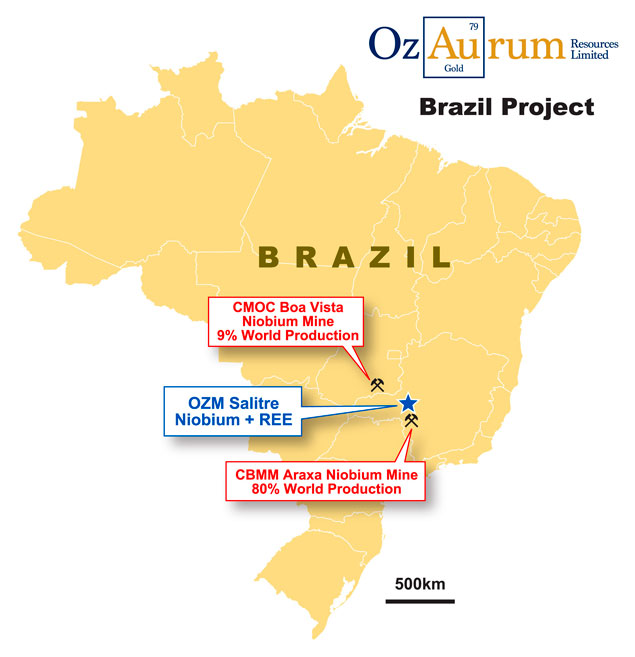
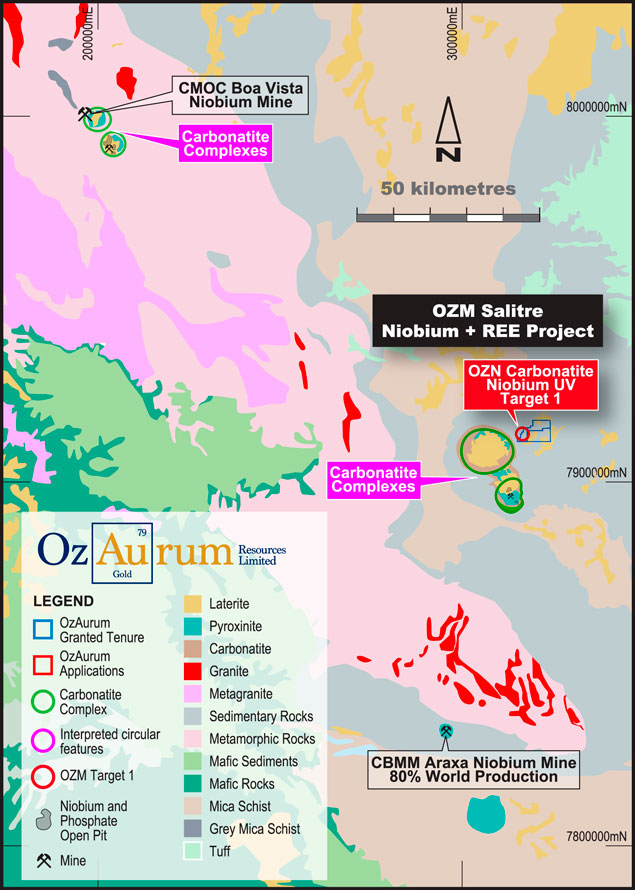
The Salitre and Catalao Niobium REE Projects were identified as prospective areas for carbonatite intrusion-related niobium mineralisation and are situated within the Alto Paranaba Magmatic Province (APMP). The APMP hosts 97% of worldwide niobium production, all from carbonatite intrusions. OZM has identified a widespread niobium in soil anomaly over a 1km² area, with a peak niobium in soil result of 271 ppm. Coincident anomalism of tantalum, hafnium, thorium follows the same pattern as Niobium.
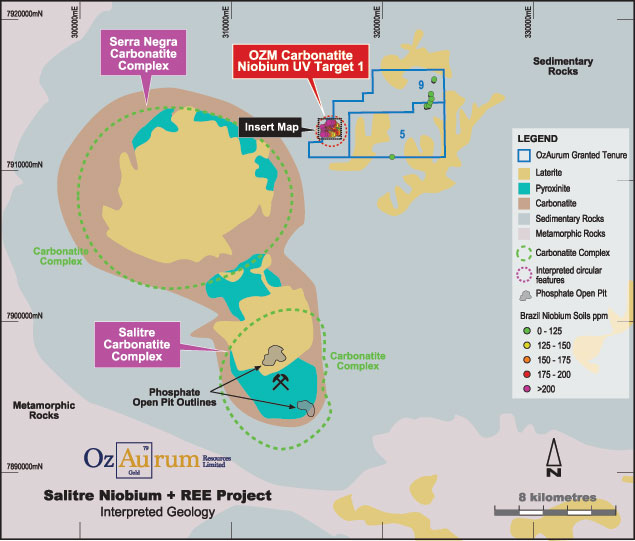
The Salitre Project is adjacent to the Salitre and Serra Negra carbonatite complexes that host significant niobium and phosphate Mineral Resources. Open pit mining and processing at the Salitre carbonatite produces phosphate, which in turn hosts niobium and rare earth minerals.
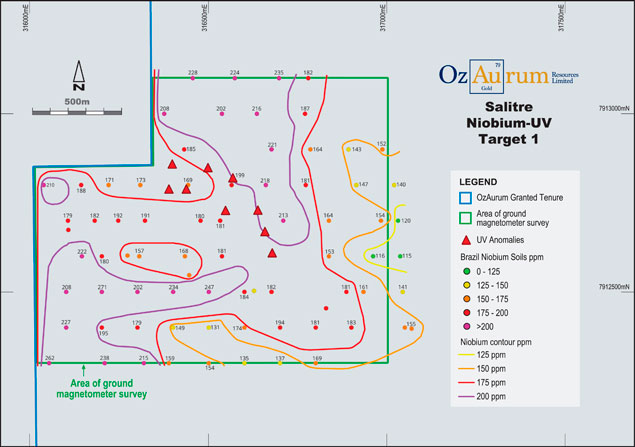
During the September 2024 quarter OzAurum undertook 2 soil sampling programs. Results of the first were announced 3 September 2024 and the second during the quarter on 21 October 2024 (see ASX announcements on those dates for detailed discussion of the exploration results). The first soils program identified an area labelled Target 1. The second program further tested this area, and we have identified a widespread niobium in soil anomaly over a 1km² area with a peak niobium in soil result of 271 ppm. Coincident anomalism of tantalum, hafnium, thorium follows the same pattern as Niobium. These are high field strength elements that along with niobium are immobile in the regolith profile. This potentially suggests a niobium rich carbonatite intrusion as the source of the anomalism. These latest results support and validate our niobium carbonatite intrusion exploration model.
Target 1 at the Saltire Project was identified as an ultra violet (UV) anomaly by consultant Dr Neil Pendock. OzAurum considers this to be an exciting niobium carbonatite exploration project based on coincident high gamma radiation readings and a cluster of nine UV anomalies within a large niobium anomaly over a 1 km² area.
OZM has reduced its tenure and associated holding costs in Brazil to focus on the Target 1 area.
OZM plan to undertake a Magnetometer Survey with company owned ground magnetometer. A small survey on a 50m x 25m grid will be undertaken over the same area as the Niobium soil sampling. OZM expects this survey to commence in November 2025 and advises that this will not be a high precision survey as the magnetometer does not have diurnal correction. In the opinion of the experienced operator, the results will be suitable to detect any significant magnetic response. Niobium mineralisation at the Brazil Catalao II carbonatite has a distinguishable magnetic response that is characterized by three areas Morro do Padre, Boa Vista, and Marcos) dominated by dyke swarms of tetraferriphlogopite phoscorites and carbonatites cutting through fenitized Precambrian metavolcanosedimentary rocks . The Boa Vista open pit mine is currently being mined for Niobium.